
服務熱線:
400-900-8020
010-62885670

云道熱點 | 哥大校長2022畢業演講
來源:www.ccjxzk.cn 發布時間:2022年07月11日
演講內容如下
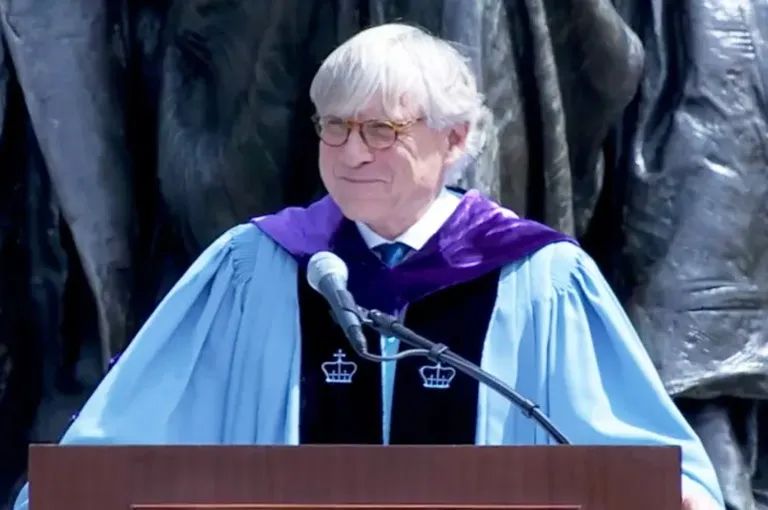
李·布林格說,“我擔心的一個問題——不是審查,而是那些過度地濫用自由表達而產生的大量嚴重誤導的言論,這些言論威脅著我們道德、倫理、公正、明智和理智的世界。我擔心濫用言論自由的現象越來越普遍。
首先,我們必須認識到一個明確的、至關重要的問題,如今系統的造謠行徑正在滋生和放大我在開篇就指出的危機。否認疫苗的有效性、否認氣候科學、否認選舉的公正性、否認歧視對過去和現在造成的影響,這些以及如此多的其他惡意傳播錯誤信息的行為正在侵害我們的思想。
我們都非常清楚,互聯網作為我們這個時代巨大的進步,正在被用來擴大這些危害行徑的影響,而且可能達到了人類社會從未遇到過的程度。
On May 18, 2022, President Bollinger delivered his first in-person Commencement address in three years.
On behalf of our Trustees, our faculty, our distinguished alumni, our families, and our many friends of Columbia University, it is my very, very great pleasure to welcome all of you gathered here today—and, notably, for the first IN PERSON commencement in three years. I am also delighted to welcome the tens of thousands of you who are joining us virtually, a way of being together we have come to know so intimately. We are all here to continue our 268-year tradition of celebrating the significant achievements of our graduates, representing seventeen schools, along with our affiliate institutions of Teachers College and Barnard.
So, I cannot imagine beginning my remarks to you in any other way than by acknowledging the extraordinary context, really the historical context, in which you have been students at Columbia and in which you have arrived at this remarkable milestone in your lives. This is always a magnificent ceremony—striking in this grand academic setting, in the parade of colors and in the joyful faces.
Satisfying the requirements for a Columbia degree is never easy; the demands are as rigorous as any in the world. So, you should, indeed, be very proud. We, certainly, are of you. But, as much as we, your faculty, admire you and are proud of what you have achieved, nothing can compare to the pride of your family and friends who have supported you all along the way. Please take this opportunity to thank them.
Under
ordinary conditions, we justifiably celebrate the sheer labor and
talents that have brought you to this point. But your Columbia journey
has been nothing like any I have ever witnessed. I can barely begin to
touch the surface of the times: A once-in-a-century pandemic;
life-jarring climate-induced catastrophes jolting us into a
state-of-emergency mindset; a world flirting dangerously with
authoritarianism, repressing human rights and yielding naked aggression
to a degree not seen since the era leading up to the Second World War;
violent acts of racism that add still another horrible chapter in the
struggles of Black Americans to overcome invidious discrimination, made
worse by a refusal of many citizens even to acknowledge the historical
and ongoing truths of this injustice; and of other innocent groups,
suffering other injustices. Together these forces seem biblical, in
scope and in gravity. As I recite these multiple and intersecting
plagues of our time, I know each one of us is privately taking stock of
how these events—singly or altogether—have affected our own lives and
the lives of those close to us.
Collectively,
we can be certain that many among us have suffered deeply; and not one
of us has been untouched. To all of you, therefore, in recognition of
the many challenges you have had to endure and overcome, we say with
more conviction and more respect than ever before, Congratulations to
the Class of 2022.
We have, it seems, entered what we might call the Age of Disinformation.
My
remarks to you this morning are about matters that are dear to my heart
(and I hope dear to yours, as well)—as they involve free speech, deep
knowledge and expertise, universities and their role in making a good
society and the responsibilities we all bear, especially in these
momentous times, to think clearly and to think well, no matter what we
are doing. It is common for me on these occasions to speak about the
glorious principles of freedom of expression and its offspring of
academic freedom. But on this day what concerns me is a different
problem—not of censorship, but instead of an over-abundance, an excess,
an abuse of freely expressed but deeply misguided speech that threatens a
moral, ethical, just, wise, and sane world. I’m concerned about the
increasingly pervasive misuse of free speech.
Let
me start with what is clear and critically important to
recognize—namely, that the modern phenomenon of systematic campaigns of
disinformation is spawning and amplifying the very crises I noted at the
outset. Denials of the effectiveness of vaccines, of climate science,
of election integrity, of the past and ongoing effects of
discrimination—these and so many other malicious efforts at
misinformation are polluting our collective mind. We are all very much
aware that the great advancement of our age, the Internet, is being used
to augment the malign effectiveness of these campaigns, and probably to
a degree never encountered before in human societies. Just a few
decades ago a crackpot theory or idea had a lot of hard work ahead in
order to break into the general population where it could use anger and
paranoia to take root. Now it happens in seconds. We have, it seems,
entered what we might call the Age of Disinformation.
This is no
small matter. From a First Amendment standpoint, I can tell you that
this poses urgent questions. Over the course of the last century, and
especially in the last half century, we have created the most
speech-protective society in the world—indeed, in human history. At its
core, there is a simple premise: Bad speech, including falsehoods and
lies, is better remedied by opportunities for more speech rather than by
government intervention. This means we live in a wilderness of human
thoughts and ideas, with the hope that we might become more
intellectually self-reliant and capable of tolerance.
We
know by nature we are not perfect. We know there is a natural human
impulse to latch onto beliefs, to group with others who believe
similarly and will provide mutual reinforcement of our rightness, which
then manifests itself in a concerted drive to convert or stop those who
disagree, thus producing a cycle of escalating intolerance. We are not
born believing in the First Amendment. Indeed, openness of mind is
counter-intuitive; it must be learned both in principle and in lived
experience, and our worst impulses that we constantly have to live with
mean it will always be in jeopardy. Which is why we had to create a
hard-to-change constitutional freedom and then take it to an extreme, as
a lesson in life in tolerance. But the profound question before us
today is: Does this basic premise, does all of this still hold true?
Deliberate
disinformation and propaganda also, and more importantly, undermine the
very idea of deep knowledge and expertise itself.
Like
any fundamental principle, however, the First Amendment is far more
complex than this little précis presents, and we have allowed it to
adjust to new circumstances in the past. It is worth noting that the
last new technology of communication—namely, broadcast media—was
regulated in the public interest precisely in order to deal with many of
the very same dangers we now see with social media and related
platforms on the Internet. This stands as a potential model for us now.
And that is where the debate is taking place.
But let’s return to understanding the problems we are facing and the gravity of the threats. There is more than simply the circulation of particular falsehoods. Deliberate disinformation and propaganda also, and more importantly, undermine the very idea of deep knowledge and expertise itself. Disinformation is now powering a particularly pungent form of populism in which experts are discredited, even ridiculed, and an arrogance of feeling one can believe whatever one wants to believe is settling in and becoming normal. This attitude is in direct conflict with universities, because we are society’s primary institutions for preserving and advancing what humanity has struggled to learn over the millennia. Over the past several years, our own faculty have been targets of this abuse.
But
the dangers are even worse: Attacking expertise is a common tool of
fascism and authoritarian regimes. When we discredit a particular piece
of knowledge, we make it harder to think well. We undermine the
essential task of a self-determining society to draw on the vast body of
information and thought painfully developed over centuries and held
safely within our academic institutions and across our cultural
institutions and professions. Falsehoods today are increasingly
accompanied by a rejection of a necessary humility about the limits of
our knowledge and of a basic trust in others who have devoted their
lives and careers to understand deeply an important subject.
So, the
stakes are, indeed, very high, and we, universities, along with the
democracy as a whole, are vulnerable to these campaigns and new
conditions. The issue is then what comes next. Let us assume that the
First Amendment will be rethought. It is time to ask: How can we think
about all of this outside the First Amendment?
“Good
thinking” is a critical goal of any individual or society. The
rejection of “bad thinking”—however difficult it is to define
precisely—is a necessary condition of that.
There
is, of course, much to say about this, but I have two key points: One
is not to let free speech stand in the way of condemning disinformation
and doing all we can to stop it; the other is to think of universities
as the models for society and how to think.
It is increasingly dangerous to assume, as many long have, that the strong protections afforded falsehoods under the First Amendment necessarily implies that it is wrong to do what we can to stop falsehoods and disinformation generally. Is “free speech” an “absolute,” as some would have it, and should we, accordingly, refrain from doing anything to stop bad speech in ways beyond official censorship? My answer to that is: Not for a second should we think that way. That way lies madness and the loss of a well-educated society.
“Good thinking” is a critical goal of any individual or society. The rejection of “bad thinking”—however difficult it is to define precisely—is a necessary condition of that.
Indeed, this is what we call education—the development of the human capacity to think well—with reason from knowledge, and with respect for facts and a reasonable openness to relevant ideas and opinions. This is not easy, to be sure, which is why we devote so many years to arrive at where you are now.
In
fact, the very human impulses noted at the outset that lead us to
improperly censor others also lead us to think badly by not rejecting
what we should. Not to put too fine a point on it, but, if a student
receives an F for a lazy paper filled with falsehoods, it will not do
the student any good to proclaim that the paper should not be penalized
because it was an exercise in freedom of speech. “Free speech” is not an
end in itself but a thumb on the scale in a particular direction. It
would make no sense to order our lives entirely in that direction. Keep
it always in mind, of course, but do not allow it to take precedence
over other principles we value—in the case of the failing paper, the
importance of sharp thinking and quality writing.
Whenever I let my mind try to take in the full breadth of what happens
here—in laboratories, in clinics, in libraries, in studies, in
classrooms, and work all over the planet—I am exhilarated.
This
brings me, lastly, to the importance of institutions in
society—institutions such as universities, the press, and other civic
institutions. We need to recognize that these institutions are designed
to help organize our discussions, not just about politics but, really,
about everything. Those of us here today have been incredibly fortunate
to be part of this great university. Whenever I let my mind try to take
in the full breadth of what happens here—in laboratories, in clinics, in
libraries, in studies, in classrooms, and work all over the planet—I am
exhilarated. But I am also filled with humility because I know so
little of all that is known here, and at similar institutions. To come
to a university such as Columbia is to learn to be humble; to realize
how little you know and always will.
I love being president (I recommend the job highly!), not least because I get to know just a little bit more of that amazing whole. In this time of our many trials and crises, as we reap the benefits of universities, we need to do all we can to protect them. They are not perfect, for sure. I feel strongly, for example, that we need to make the boundaries between us and the rest of the world more permeable and more connected in the betterment of human society and the world. This mission, which I call the Fourth Purpose of the University—in addition to teaching and research and service—might help people more broadly feel more respectful of what we have to offer.
But another reason I love being president of Columbia is the opportunity to be in your midst. As students in our classrooms and laboratories, you are what makes academic life worth living. We may be daunted by this troubled moment in history, but I am most certainly convinced, to the core of my being, that every one of you in your own way will help to solve these problems and to heal the world. You have demonstrated that human capacity to think well, and I know you will deploy it in meaningful and inspiring ways. Most of all, you will have the proper degree of humility that a truly great education instills.
On
this day, we celebrate you, all that you have accomplished, and the
institution that nurtures us, especially in this new historical era we
have entered.
Congratulations to you, Class of 2022.

有任何申請問題
掃描二維碼聯系小助手吧